The Real Cost of Building a Mobile App in 2026 — What Founders Must Know
Building a mobile app in 2026 isn’t just about hiring developers anymore. Between AI integration, cross-platform frameworks, and increasingly complex user expectations, founders face a maze of technical and financial decisions that can make or break their startup budget. According to the U.S. Bureau of Labor Statistics, software developer costs have increased by 18% since 2023, while a 2025 National Science Foundation study reveals that 67% of mobile apps exceed their initial budget projections. Whether you’re bootstrapping your first MVP or scaling an existing product, understanding the real costs, hidden fees, and strategic trade-offs is critical. This guide breaks down everything you need to know about mobile app development costs in 2026, from initial design to post-launch maintenance, so you can plan realistically and avoid the costly mistakes that derail most first-time founders.
Understanding the Basics
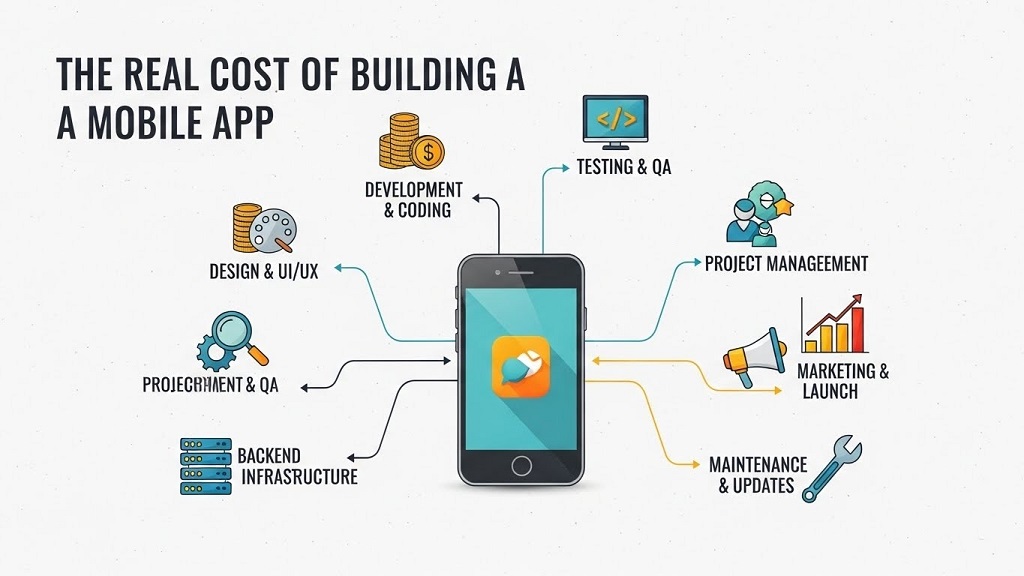
Mobile app development costs vary dramatically based on complexity, platform choice, and team structure. A simple app with basic features might cost $40,000 to $80,000, while a complex app with custom animations, backend infrastructure, and third-party integrations can easily exceed $300,000 to $500,000. The main cost drivers include design work, frontend and backend development, quality assurance testing, and ongoing maintenance.
Think of app development like building a house. You can buy a prefabricated kit home for a fraction of the cost of a custom-designed residence, but you’ll sacrifice uniqueness and specific features. Similarly, using no-code platforms or templates reduces costs but limits customization. Custom development gives you complete control but requires significantly more investment.
The 2026 landscape has shifted toward hybrid approaches. Many founders now build their MVP using low-code tools to validate their concept, then gradually transition to custom development as they scale and secure funding.
Why This Topic Matters
Understanding app development costs protects founders from financial disaster and enables smarter strategic planning. Here’s why this knowledge is crucial:
- Prevents budget overruns: Without accurate cost estimates, 67% of startups exhaust their runway before launching
- Enables strategic fundraising: Knowing real costs helps you raise the right amount from investors
- Informs build vs. buy decisions: You can evaluate whether building custom or using existing solutions makes financial sense
- Reduces technical debt: Proper budgeting allows for quality development rather than rushed, poorly-coded solutions
Consider Sarah, a healthcare founder who budgeted $60,000 for her telemedicine app based on outdated 2022 estimates. She didn’t account for HIPAA compliance requirements, secure video infrastructure, or iOS and Android platform differences. Six months in, she’d spent $85,000 with only 60% functionality complete. She had to pause development, dilute equity further, and restart with proper cost planning. Her story isn’t unique, it’s the norm when founders underestimate the true cost of mobile app development.
Key Components of Mobile App Development Costs
Design and User Experience (10-15% of total cost)
Design encompasses everything users see and interact with, from wireframes to final visual polish. In 2026, this includes designing for multiple screen sizes, dark mode, accessibility features, and platform-specific conventions. Expect to invest $8,000 to $40,000 depending on complexity.
Professional UI/UX design isn’t optional anymore. Users compare every new app to polished experiences from companies like Spotify, Airbnb, and Duolingo. A freelance designer might charge $50 to $150 per hour, while agencies typically charge $100 to $250 per hour. The design phase usually takes 4 to 8 weeks for a mid-complexity app.
Development (50-60% of total cost)
This is where your budget takes its biggest hit. Development splits into frontend (what users see), backend (server logic and databases), and API integrations. For native apps, you’ll need separate iOS and Android development, potentially doubling costs. Cross-platform frameworks like React Native or Flutter can reduce this by 30 to 40%.
Hourly rates vary globally: North American developers charge $100 to $200 per hour, Eastern European teams $40 to $80, and South Asian developers $20 to $50. A mid-complexity app typically requires 800 to 1,500 development hours. The math gets expensive quickly, which is why many founders opt for offshore teams or hybrid models combining senior local architects with offshore implementation teams.
Testing and Quality Assurance (15-20% of total cost)
QA testing catches bugs before users do, saving your reputation and reducing support costs. In 2026, this includes automated testing, manual testing across dozens of device types, performance testing, security audits, and accessibility compliance testing. Budget $10,000 to $50,000 depending on app complexity.
Skimping on QA is false economy. Every dollar saved here typically costs five to ten dollars in post-launch bug fixes, negative reviews, and user churn. Professional QA teams test edge cases that developers miss, ensure the app performs well on older devices with limited memory, and verify that features work across different OS versions.
Maintenance and Updates (15-25% of annual development cost)
Most founders forget this crucial ongoing expense. Apps require regular updates for new OS versions, security patches, bug fixes, and feature improvements. Plan to spend 15 to 25% of your initial development cost annually just maintaining the app. A $100,000 app will cost $15,000 to $25,000 yearly to keep functional and secure.
Practical Tips You Can Apply Today
Start with a detailed feature prioritization: List every feature you want, then ruthlessly categorize into Must Have, Should Have, and Nice to Have. Build only Must Have features for your MVP. This single exercise typically cuts initial costs by 40 to 60%.
Get multiple detailed quotes: Contact at least three development teams and request itemized estimates. Prices vary wildly, and detailed quotes reveal what each team includes or excludes. Watch for vague line items, those hide future cost surprises.
Use fixed-price contracts for defined scopes: If your requirements are clear, fixed-price protects you from runaway hourly billing. Include specific milestones and deliverables. Add a 10 to 15% contingency buffer for inevitable scope adjustments.
Consider a phased approach: Build your core MVP first, launch to real users, gather feedback, then add features iteratively. This spreads costs over time and ensures you’re building what users actually want rather than what you assume they need.
Negotiate payment terms strategically: Split payments into milestone-based installments rather than hourly billing. Typical structure includes 20 to 30% upfront, 40 to 50% during development milestones, and 20 to 30% on final delivery. This protects both parties and ensures accountability.
Common Mistakes and How to Avoid Them
Building for both platforms simultaneously: First-time founders often insist on launching iOS and Android together, doubling their initial costs. Instead, analyze where your target users actually are and launch on one platform first. Use the single platform to validate your concept, gather feedback, and generate revenue before expanding. This approach cuts initial costs by 40 to 50% and reduces risk.
Underestimating backend complexity: Many founders budget for the app interface but forget the backend infrastructure that powers it. Authentication systems, databases, APIs, push notifications, and analytics all require backend development. Budget at least 40% of your development cost for backend work, or consider Backend-as-a-Service solutions like Firebase or Supabase for MVPs.
Ignoring post-launch costs: The app store approval, initial marketing, customer support setup, server hosting, and first-month bug fixes often cost 20 to 30% of the development budget. Set aside funds specifically for launch month, you’ll burn through cash quickly as you onboard initial users and address their feedback.
Choosing developers by price alone: The cheapest quote is rarely the best value. A $30/hour developer who takes 2,000 hours costs more than a $100/hour developer who delivers in 600 hours. Evaluate portfolios, check references, review code samples, and assess communication skills. Poor development creates technical debt that costs exponentially more to fix later.
Real Example: A SaaS Founder’s Cost Journey
Marcus launched a fitness coaching app in early 2025 with a $75,000 budget. He initially contacted a U.S. agency that quoted $180,000, way beyond his seed funding. After research, he chose a hybrid model: a senior U.S. developer as technical architect ($120/hour, 200 hours) paired with a Ukrainian development team ($50/hour, 800 hours).
His actual costs broke down as follows: Design and wireframes cost $12,000, frontend development $28,000, backend and API development $22,000, QA testing $8,000, and project management $5,000. Total spent was $75,000 as budgeted. However, he encountered three unexpected costs: App Store and Google Play developer accounts cost $200, push notification service subscription was $800 for the first year, and he spent $6,500 on bug fixes during the first two months post-launch that his original QA didn’t catch.
Marcus’s key insight? He launched with seven core features instead of his originally planned eighteen. He prioritized workout tracking, video exercise library, and basic progress analytics. He cut social features, meal planning, and AI-powered recommendations for version two. This focus allowed him to launch on budget, gain 3,000 users in six months, and raise a proper Series A to build the full vision. His advice to other founders: cut features aggressively, invest in a great technical advisor even if they’re expensive, and always budget 20% more than your highest quote for unexpected costs.
Final Thoughts
Building a mobile app in 2026 requires clear-eyed financial planning and strategic prioritization. Whether you spend $40,000 or $400,000 depends on your feature scope, team choice, and quality expectations. The founders who succeed aren’t necessarily those with the biggest budgets, they’re the ones who understand their true costs, make informed trade-offs, and build iteratively based on real user feedback.
Start by defining your absolute minimum viable product, get detailed quotes from multiple teams, and budget for the hidden costs everyone forgets: maintenance, hosting, marketing, and post-launch support. Remember that app development is a marathon, not a sprint. Launch lean, validate your concept, then invest in polish and additional features as you grow.
Ready to build your app? Create a detailed feature list today, categorize each feature by priority, and reach out to three development teams for quotes. The clarity you gain in the next two weeks will save you months of expensive mistakes.
FAQs
How much does it cost to build a simple mobile app in 2026?
A simple app with basic features, minimal backend, and straightforward design typically costs $40,000 to $80,000. This includes native development for one platform (iOS or Android), basic user authentication, a simple database, and fundamental UI screens. Using cross-platform frameworks or no-code tools can reduce this to $15,000 to $30,000, but with limitations on customization and performance.
Should I build for iOS or Android first?
Choose based on your target audience, not personal preference. In North America and Western Europe, iOS users typically spend more on apps and in-app purchases, making it the better choice for B2C monetization. Android dominates in developing markets and has larger global user numbers. Check your competition and analyze where your specific target users spend their time. Most successful startups launch on one platform, validate their concept, then expand.
What are the ongoing costs after launching my app?
Expect annual maintenance costs of 15 to 25% of your initial development cost. This includes hosting and backend infrastructure, app store fees, bug fixes and updates for new OS versions, security patches, customer support tools, analytics and monitoring services, and periodic feature updates. A $100,000 app typically requires $15,000 to $25,000 annually just to keep running smoothly.
Can I build an app cheaper using no-code platforms?
Yes, but with significant trade-offs. No-code platforms like Bubble, Adalo, or FlutterFlow can reduce costs to $5,000 to $20,000 for simple apps. They’re excellent for MVPs and validation. However, you’ll face limitations on custom features, performance issues with complex logic, difficulty integrating certain third-party services, and challenges scaling to hundreds of thousands of users. Many successful startups use no-code for validation, then rebuild custom once they’ve proven market fit.
How long does it take to develop a mobile app?
A simple app takes 3 to 4 months from concept to launch, medium complexity apps require 5 to 8 months, and complex apps with extensive features need 9 to 18 months. This timeline includes design, development, testing, revisions, and app store approval. Rush jobs cut corners that create technical debt, so realistic timelines actually save money long-term. Factor in at least 2 to 4 weeks additional time for app store review and approval processes.
Related Topics: Why Startups Get High Traffic but Low Conversions (And How to Fix It Fast)
Related Topics: Six features every school website should have
References
- U.S. Bureau of Labor Statistics – Occupational Employment and Wages, Software Developers: https://www.bls.gov/oes/current/oes151252.htm
- National Science Foundation – Business Research and Development Survey: https://www.nsf.gov/statistics/srvyindustry/
- Small Business Administration – Technology and Innovation Cost Analysis: https://www.sba.gov/business-guide/plan-your-business/fund-your-business
- International Data Corporation (IDC) – Worldwide Mobile App Development Spending Guide: https://www.idc.com/getdoc.jsp?containerId=IDC_P38735