Benefits of Choosing Laravel for Enterprise Web Applications
Laravel is one of the best frameworks for enterprise web applications because it combines security, scalability, rapid development, and long term maintainability. Businesses benefit from built in authentication, powerful database tools, automated testing, and a mature ecosystem that reduces development time while supporting complex business requirements.
Enterprise organizations demand web applications that remain secure, scalable, and easy to maintain as operations grow. Laravel meets those expectations with a modern architecture, extensive built in features, and an active development ecosystem. Industry surveys consistently show PHP powering more than 70% of websites with known server side languages, while Laravel remains one of the most widely adopted PHP frameworks. Its growing ecosystem and continuous feature updates help development teams deliver enterprise grade applications faster without sacrificing code quality or future flexibility.
Why Enterprises Select Laravel
Large organizations need software that supports continuous growth without creating unnecessary technical debt. Laravel provides a structured framework that simplifies development while encouraging clean coding practices.
Instead of building common features from scratch, developers can use reliable built in tools. As a result, projects reach production faster with fewer implementation errors.
Businesses also appreciate Laravel because it supports modern development workflows. Therefore, teams can collaborate efficiently across multiple departments and development stages.
Strong Security Features
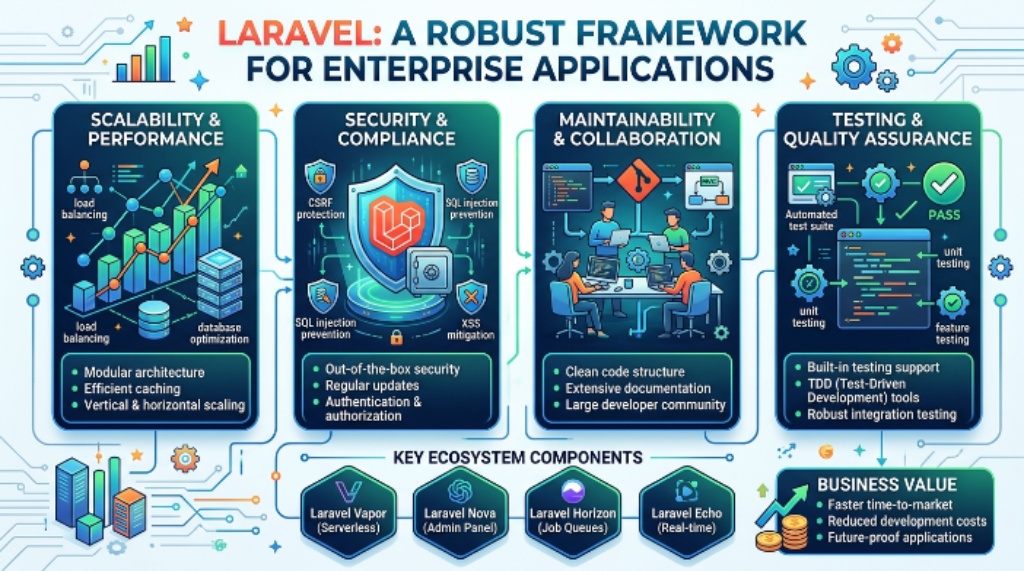
Security remains a top priority for every enterprise application. Laravel includes several protective features that reduce common security risks.
Built in security capabilities include:
- Authentication and authorization
- Password hashing
- Cross site request forgery protection
- SQL injection prevention
- Cross site scripting protection
- Secure session management
- Rate limiting
These features help organizations build secure applications without depending heavily on third party solutions.
Built In Authentication
Laravel provides ready to use authentication systems. Consequently, developers spend less time creating login and user management features.
Role based access control also becomes easier to implement. This approach protects sensitive company data from unauthorized access.
Data Protection
Sensitive business information requires multiple protection layers. Laravel supports encrypted data handling and secure password storage throughout the application.
Regular security updates also help businesses remain protected against newly discovered vulnerabilities.
Excellent Scalability
Enterprise applications often experience rapid user growth. Laravel supports scalable architectures that expand alongside business needs.
Developers can divide workloads across multiple services. Therefore, applications continue performing well even during heavy traffic periods.
Queue Management
Many enterprise tasks require background processing. Laravel queue management handles emails, reports, notifications, and imports without slowing user interactions.
This approach improves both application speed and customer satisfaction.
Caching Support
Laravel integrates with popular caching systems. Consequently, frequently requested data loads much faster.
Better caching reduces server load while improving overall application responsiveness.
Faster Development Process
Development speed directly affects project costs. Laravel includes numerous built in tools that eliminate repetitive programming tasks.
Developers can focus more on solving business problems. Meanwhile, the framework manages common infrastructure components.
Important productivity features include:
- Elegant routing
- Database migrations
- Object relational mapping
- Command line tools
- Automated validation
- Background jobs
- Task scheduling
These capabilities reduce development effort while improving software consistency.
Clean Code Architecture
Enterprise software usually remains active for many years. Clean architecture makes future maintenance significantly easier.
Laravel encourages organized project structures. Therefore, developers understand application logic quickly even after several years.
Well organized code also supports easier debugging and feature expansion.
Model View Controller Pattern
Laravel follows the Model View Controller architecture. This design separates business logic from presentation and data handling.
As a result, teams can develop and maintain different application components independently.
Reusable Components
Developers can create reusable services, middleware, and controllers. Consequently, large projects avoid unnecessary duplicate code.
Reusable components also improve testing and long term stability.
Powerful Database Management
Enterprise systems frequently process millions of records. Laravel simplifies database operations without reducing flexibility.
Its Object Relational Mapping system allows developers to work with databases using readable application code instead of lengthy queries.
Database migrations also simplify deployment across multiple environments.
Migration System
Database structure changes become predictable through migration files. Teams can track every modification during development.
This process greatly reduces deployment errors across testing and production servers.
Database Relationships
Laravel handles complex database relationships efficiently. Therefore, developers spend less time managing joins and related records manually.
Complex enterprise data becomes easier to organize and maintain.
Better Performance Optimization
Performance influences both customer experience and operational efficiency. Laravel provides several optimization techniques that improve application speed.
Performance improvements include:
- Route caching
- Configuration caching
- View caching
- Lazy loading control
- Background processing
- Optimized database queries
Together, these features support responsive enterprise applications under heavy workloads.
Automated Testing Support
Reliable enterprise software requires continuous testing. Laravel includes testing tools that simplify quality assurance.
Developers can verify application behavior before deployment. Consequently, production issues become less frequent.
Testing also supports faster feature releases because teams gain greater confidence in application stability.
Easy Third Party Integration
Modern businesses rely on multiple software platforms. Laravel connects smoothly with external services through APIs.
Common enterprise integrations include:
- Payment gateways
- Customer relationship management platforms
- Enterprise resource planning systems
- Cloud storage
- Email services
- Analytics platforms
These integrations support unified business operations without unnecessary complexity.
Strong Ecosystem
Laravel offers an extensive ecosystem that expands development possibilities.
Popular ecosystem tools help organizations manage authentication, monitoring, administration panels, real time communication, background processing, and deployment.
Because these tools share consistent development standards, implementation remains efficient across enterprise projects.
Lower Long Term Costs
Development costs extend beyond the initial launch. Maintenance often becomes the largest long term expense.
Laravel reduces maintenance costs through organized architecture, reusable code, and comprehensive documentation.
Businesses also benefit from a large global developer community. Therefore, finding experienced developers remains easier than supporting proprietary platforms.
Better Team Collaboration
Enterprise applications usually involve multiple developers. Laravel encourages consistent coding standards that improve collaboration.
Clear project organization reduces onboarding time for new developers.
Version control workflows also become easier because project structures remain predictable.
Cloud Ready Deployment
Modern enterprises increasingly deploy applications in cloud environments. Laravel supports scalable cloud infrastructure without requiring major architectural changes.
Applications can expand as business demand increases. Consequently, organizations avoid expensive platform migrations later.
Ideal Enterprise Use Cases
Laravel performs exceptionally well across many enterprise scenarios.
Common enterprise applications include:
- Customer portals
- Business management platforms
- Healthcare systems
- Financial dashboards
- Ecommerce platforms
- Learning management systems
- Human resources software
- Inventory management systems
- Software as a Service platforms
Each application benefits from Laravel’s scalability, security, and maintainability.
Tips for Successful Laravel Enterprise Development
Follow these practices for better project outcomes:
- Design application architecture before coding.
- Separate business logic into dedicated services.
- Write automated tests from the beginning.
- Optimize database queries regularly.
- Enable caching where appropriate.
- Monitor application performance continuously.
- Keep framework dependencies updated.
- Apply strict security policies across all environments.
These practices help maintain stable enterprise applications throughout their lifecycle.
Conclusion
Laravel provides an outstanding foundation for enterprise web applications by combining strong security, rapid development, clean architecture, and excellent scalability. Organizations gain lower maintenance costs, faster feature delivery, and reliable long term performance through its mature ecosystem. If your business plans to build or modernize a complex web application, Laravel offers a dependable framework that supports growth while maintaining development efficiency and software quality.
FAQs
Is Laravel suitable for large enterprise applications?
Yes, Laravel supports scalable architectures, advanced security, and enterprise level development workflows.
Does Laravel provide built in security features?
Yes, Laravel includes authentication, authorization, encryption, password hashing, and multiple protections against common attacks.
Can Laravel integrate with existing enterprise software?
Yes, Laravel supports API integrations with payment systems, CRM platforms, ERP software, cloud services, and other business tools.
Does Laravel reduce development time?
Yes, built in features and automation tools significantly shorten development while maintaining code quality.
Is Laravel easy to maintain over time?
Yes, its organized architecture, reusable components, and testing support simplify long term maintenance.